
Y strainers — the cheapest part you'll ever regret skipping.
In-line Y-type strainers from DN25 to DN400, flanged or buttweld, in grey iron through CF3M. Fitted upstream of pumps, control valves, meters and heat exchangers, they catch the weld slag, scale and grit that would otherwise arrive at something expensive.
- DN25–DN400
- PN10 / #150 / #300
- Flanged & buttweld
- Cast iron to CF3M
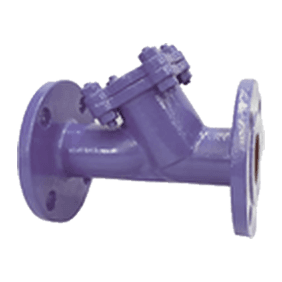
A Y strainer is a body with an angled branch holding a perforated or mesh screen. Flow passes through the screen, debris collects in the leg, and a blowdown connection lets you flush it without breaking the line. There is nothing clever about it — which is exactly why it is the most commonly skipped item on a piping schedule and the most common root cause of a wrecked mechanical seal.
New pipework is the worst offender. Weld slag, cutting swarf, thread tape and construction debris all get flushed straight into the first piece of rotating equipment downstream. On existing systems it's scale, corrosion products and biofilm. In both cases the strainer costs a fraction of the pump seal, control valve trim or plate heat exchanger it protects.
Specifications.
Figures below are the catalogue envelope. Final model, seat and trim are confirmed against the ALLSEN catalogue before we quote.
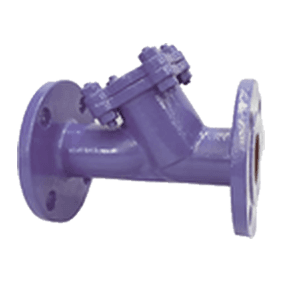
Y-Type Strainers
Angled-branch strainer body with a removable screen and blowdown connection. Available in grey iron for water and HVAC service, WCB for general industrial duty, and the CF8 / CF8M / CF3 / CF3M stainless grades for corrosive and hygienic-adjacent lines.
| Size range | DN25 – DN400 |
|---|---|
| Material of construction | IS 210 Gr FG 200 | WCB | CF8 | CF8M | CF3 | CF3M |
| Pressure rating | PN10, #150, #300 |
| End connection | Flanged, buttweld |
| Application | Wastewater, pulp & paper, power plants, mining, chemical plants, HVAC, oil & gas |
Four places a strainer pays for itself in the first year.
Strainers are a maintenance item, not a fit-and-forget one — but each of these positions protects something that costs an order of magnitude more than the strainer does.
Upstream of every pump
Protects the mechanical seal, wear rings and impeller. On new installations this is the single highest-value strainer on the plant — commissioning debris is what kills first-year seals.
Upstream of control valves
Control valve trim has tight clearances and a small particle wedged in the seat means the valve neither closes nor controls. Also applies to pressure-reducing and safety-relief stations.
Upstream of heat exchangers
Plate exchangers block on debris that a shell-and-tube would pass. A strainer keeps the plate pack clear and keeps your approach temperature where it was designed to be.
Upstream of flow meters
Turbine, positive-displacement and insertion meters are all vulnerable to particulate — and a damaged meter costs you billing accuracy long before it obviously fails.
Fit a pressure gauge either side, or a differential gauge across the strainer. Rising differential pressure is your signal to clean it — not a fixed calendar interval.
Where this valve does the work.
Pump protection
The most common installation. Catching commissioning debris and pipeline scale before it reaches the mechanical seal, wear rings and impeller.
HVAC & chilled water
Protecting chillers, plate heat exchangers, control valves and circulating pumps in building services and data-centre cooling circuits.
Process & utility lines
Grey iron and WCB bodies on general utility duty; CF8M and CF3M on chemical, pulp & paper and corrosive process service.
Oil & gas
Buttweld-end strainers in WCB and stainless grades on hydrocarbon and utility lines at #150 and #300 class.
Mesh size is the specification — the body is the easy part.
Pick the screen first. Too coarse and the debris you were worried about goes straight through; too fine and the strainer blinds off in days, starves the pump and causes the cavitation you installed it to prevent. Match the perforation or mesh to the smallest clearance you're protecting — control valve trim and plate exchangers need finer screens than a general pump suction.
Then account for pressure drop. A clean strainer's loss is modest, but your system has to still work with the screen partly loaded. On pump suction lines this matters directly: strainer loss comes straight off your available NPSH, and a blinded suction strainer is a classic cause of cavitation on an otherwise well-designed system.
Finally, plan the maintenance. Leave clearance to withdraw the screen, fit a blowdown valve on the leg, and put gauges either side so differential pressure — not the calendar — tells you when to clean. Tell us the fluid, the expected debris and what's downstream, and we'll specify body material, end connection and screen together.
Other valves from the same catalogue.
Specifying a full line in one metallurgy is easier when isolation, regulation and non-return all come from the same source.
Butterfly Valves
Concentric, high-performance and triple-offset — every disc MOC
Dual Plate & Single Plate Wafer Check Valves
Wafer-type non-return valves, DN40–DN1200
Ball Valves
Quarter-turn tight shutoff, DN15–DN300
Knife Gate Valves
Slurry, pulp and solids-laden service, DN50–DN1200
Gate Valves
Full-bore isolation to #2500, DN15–DN1200
Globe Valves
Throttling and flow regulation, DN15–DN600
Frequently asked questions
What mesh size should I specify for a Y strainer?
It depends on what you're protecting, not on the pipe. A general pump-suction strainer is typically a coarse perforated screen; control valve and plate-heat-exchanger protection needs a finer perforation or a mesh lining; instrument and meter protection finer still. The rule is to match the screen to the smallest clearance downstream, then check that the pressure drop is acceptable when the screen is partly loaded. Tell us what's downstream and we'll specify the screen with the body.
Should the strainer go on the suction or discharge side of a pump?
Suction side, so debris never reaches the impeller or seal — but with a caveat: suction strainers eat into your available NPSH, and a blinded one will cause cavitation. Size it generously, keep the screen coarse enough for the duty, and monitor differential pressure. Where NPSH margin is already tight, a temporary conical start-up strainer during commissioning plus a discharge-side strainer is sometimes the better engineering answer. We'll look at your NPSH numbers and advise.
How is a Y strainer installed and oriented?
Flow must follow the arrow on the body — a Y strainer installed backwards does nothing. On horizontal lines the screen leg should point downward or sideways so debris collects in it and can be blown down; pointing it upward lets collected debris fall back into the line every time flow stops. On vertical lines, flow should be downward through the strainer. Leave clearance at the cover for screen removal.
How often does a Y strainer need cleaning?
Judge it by differential pressure, not by a calendar. Fit gauges either side (or one differential gauge) and clean when the drop reaches the limit set for that duty. In practice, new pipework needs cleaning within days of commissioning as construction debris flushes through, and then settles into a much longer interval once the system is clean. Fitting a blowdown valve on the leg lets you flush it without breaking the line.
Which body material do I need?
IS 210 Gr FG 200 grey iron covers water, HVAC and general low-corrosion duty economically. WCB carbon steel handles general industrial and hydrocarbon service at higher classes. CF8 and CF8M cover corrosive and chloride-bearing lines, and CF3 / CF3M are the low-carbon grades for welded assemblies and elevated temperature. Send us the fluid and we'll match it.
Need y strainers quoted?
Share size, pressure class, fluid and temperature — we'll specify the valve and quote it with the actuator.