
Swing check valves — full bore, minimum drop.
A hinged disc that swings clear of the bore under forward flow and falls back onto its seat on reversal. Almost no pressure drop when open, and the widest class range of any non-return valve here — DN15 to DN1000 from #150 through #2500.
- DN15–DN1000
- #150 to #2500
- Full bore
- Flanged & buttweld
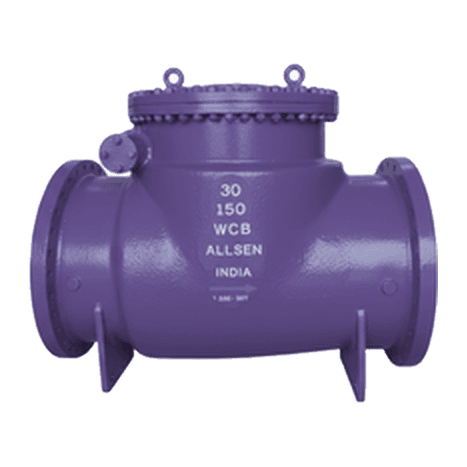
The swing check is the original non-return valve and still the right answer on a large share of lines. A hinged disc swings up out of the flow path under forward flow, so when the valve is open the bore is effectively unobstructed — the lowest pressure drop of any check valve type, which is exactly what you want on a long line where every metre of head costs pumping energy.
Where it needs thought is closure. The disc has to swing back through its full arc under gravity and reverse flow, and on a high-energy line that arc takes long enough for reverse velocity to build. Understanding that trade-off — minimum drop versus closure speed — is the whole of swing check selection.
Specifications.
Figures below are the catalogue envelope. Final model, seat and trim are confirmed against the ALLSEN catalogue before we quote.
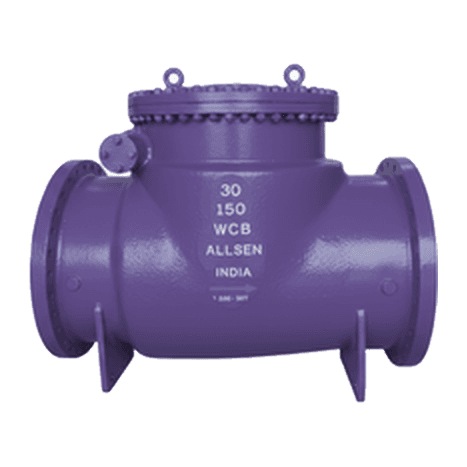
Swing Check Valves
Flanged and buttweld swing check valves from DN15 to DN1000, spanning #150 through #2500, in WCB, the CF8 / CF8M / CF3M stainless grades, Gr. 4A–5A duplex, nickel aluminium bronze and aluminium alloys — matching the gate and globe valve materials so a line can be specified in one metallurgy throughout.
| Size range | DN15 – DN1000 |
|---|---|
| Material of construction | WCB / CF8 / CF8M / CF3M / Gr. 4A–5A / NAB / aluminium alloys |
| Pressure rating | #150, #300, #600, #900, #1500, #2500 |
| End connection | Flanged, buttweld |
| Application | Wastewater, pulp & paper, power plants, mining, chemical plants, oil & gas |
Where this valve does the work.
Oil & gas
Non-return protection on hydrocarbon transfer and utility lines across the class range, with buttweld ends where flanged joints are minimised.
Power generation
Feedwater, condensate and cooling-water backflow prevention, where the high pressure classes and full-bore flow are both required.
Water transmission
Long transmission mains and pump discharge lines where low head loss over years of running outweighs the faster closure of a wafer check.
Chemical & process
Backflow protection on process lines, specified in matching metallurgy with the gate and globe valves on the same circuit.
Lowest head loss, longest closing arc — engineer for both.
Choose a swing check when pressure drop is the dominant concern: long transmission lines, large bores, and installations that run continuously where a few tenths of a bar translate into real pumping cost over a year. With the disc swung clear of the bore, this is as close to an unobstructed flow path as a check valve gets.
Choose a dual plate wafer check instead when the reverse-flow energy is high — long rising mains with significant static head, parallel pump sets, or plant that trips frequently — because the swing disc's longer travel means it can still be moving when reversal arrives. On high-energy systems, a swing check with a lever-and-weight or damped arrangement, or a switch to dual plate, is the correct engineering response.
The rest is standard: size the valve so normal flow holds the disc firmly against its stop rather than fluttering, install it in a horizontal line or a vertical line with upward flow, and give it straight pipe upstream — a check valve mounted immediately after a pump or elbow sees disturbed flow and will chatter regardless of how well it was sized.
Other valves from the same catalogue.
Specifying a full line in one metallurgy is easier when isolation, regulation and non-return all come from the same source.
Butterfly Valves
Concentric, high-performance and triple-offset — every disc MOC
Dual Plate & Single Plate Wafer Check Valves
Wafer-type non-return valves, DN40–DN1200
Y-Type Strainers
In-line pipeline protection, DN25–DN400
Ball Valves
Quarter-turn tight shutoff, DN15–DN300
Knife Gate Valves
Slurry, pulp and solids-laden service, DN50–DN1200
Gate Valves
Full-bore isolation to #2500, DN15–DN1200
Frequently asked questions
Swing check or dual plate check — which should I use?
Swing check when minimum pressure drop matters most and the reverse-flow energy is moderate: long transmission mains, large bores, continuous running. Dual plate when closure speed matters most: long rising mains with high static head, parallel pump sets, or plant that trips often. The swing disc travels through a much longer arc than a dual plate's split discs, so it closes more slowly — which is the trade you make for that unobstructed bore.
Can a swing check valve be installed in a vertical line?
Yes, provided flow is upward, so gravity assists closure and the disc falls back onto its seat. In a downward-flow vertical line the disc would be held open by gravity and the valve cannot function. In horizontal lines the valve should be oriented with the hinge pin at the top. Confirm the intended orientation with us and we'll check the specific model against the ALLSEN catalogue.
How do I stop a swing check valve slamming?
First, size it on flow so the disc sits hard against its stop in normal operation — an oversized check valve with a floating disc is the most common cause. Second, give it straight pipe upstream, away from pump discharge and elbows. If reverse-flow energy is genuinely high, the answer is either an externally levered and weighted or damped swing check, or a change to a dual plate design, alongside proper surge analysis. No check valve alone solves a serious surge problem.
What is the maximum size and pressure class available?
This swing check range runs from DN15 to DN1000 and covers #150, #300, #600, #900, #1500 and #2500 — the full class spread, matching the gate and globe valve range. That lets a whole line be specified in one metallurgy and one class family across isolation, regulation and non-return duties.
Does a swing check valve need maintenance?
It has one moving part, so relatively little — but the hinge pin and disc seat do wear, particularly if the valve has been chattering. Bolted-cover designs let you inspect the disc, pin and seat without removing the valve from the line. Persistent noise, or a valve that no longer holds back-pressure, means the pin or seat needs attention. We supply spares alongside the valves.
Need swing check valves quoted?
Share size, pressure class, fluid and temperature — we'll specify the valve and quote it with the actuator.