
Sluice valves — the waterworks standard.
Waterworks-pattern gate valves in IS 210 Gr FG 200 grey iron and WCB, DN50 to DN1200 at PN1.0 and PN1.6. Flanged, with handwheel, gearbox or electrical actuation — the isolation valve municipal water and wastewater networks are built around.
- DN50–DN1200
- PN1.0 & PN1.6
- IS 210 Gr FG 200
- Flanged
- Electrical actuation
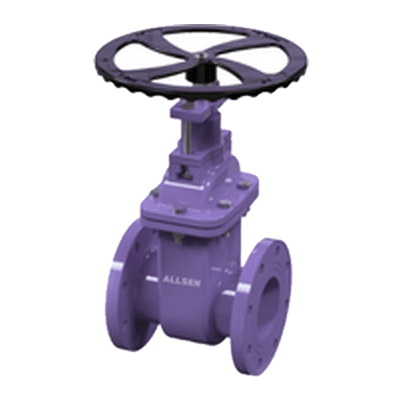
Sluice valve is the waterworks name for a gate valve built to the pressure and material conventions of water distribution: grey iron body to IS 210 Gr FG 200, flanged ends, PN1.0 or PN1.6, and a wedge that retracts fully clear of the bore. It is the valve that sits in every chamber and pit on a distribution network.
The specification is deliberately conservative, because these valves are installed in buried chambers and expected to work decades later when somebody finally needs to close them. That is the real design requirement — not peak performance, but working reliably the first time it is asked to, after twenty years of doing nothing.
Specifications.
Figures below are the catalogue envelope. Final model, seat and trim are confirmed against the ALLSEN catalogue before we quote.
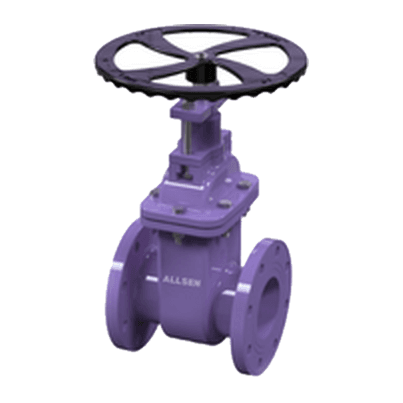
Sluice Valves
Flanged sluice valves from DN50 to DN1200 in IS 210 Gr FG 200 grey iron and WCB, rated PN1.0 and PN1.6. Handwheel operation as standard, with bevel gearbox on larger sizes and electrical actuation for remotely operated and SCADA-linked chambers.
| Size range | DN50 – DN1200 |
|---|---|
| Material of construction | IS 210 Gr FG 200 | WCB |
| Pressure rating | PN1.0 & PN1.6 |
| End connection | Flanged |
| Operation | Manual | Gear | Electrical actuated |
| Application | Water & wastewater |
Where this valve does the work.
Water distribution networks
Section isolation on distribution mains, valve chambers and district metered area boundaries — the classic buried-chamber waterworks application.
Water treatment plants
Isolation on raw water inlets, filter inlet and outlet headers, clear water wells and washwater lines throughout the treatment train.
Sewage & effluent works
Isolation on STP and ETP process lines, pumping station suction and discharge headers, and inter-stage transfer.
Pumping stations
Suction and discharge isolation around pump sets, so an individual pump can be taken out for service without draining the station.
Specify for the day, decades from now, when it finally has to close.
Sluice valves spend most of their life fully open in a buried chamber, and are judged entirely on whether they close when a burst main or a pump failure means somebody needs them to. That makes seat condition, stem protection and operability the specification priorities — not flow performance.
Get the operator right for the installation. Handwheel is standard and adequate through the mid sizes; larger valves need a bevel gearbox to bring the rim effort within what one person can apply against full line pressure. Electrical actuation earns its place in chambers that are awkward to access, in remotely operated networks and anywhere the valve is tied into SCADA — worth deciding at design stage, because retrofitting an actuator into a finished chamber is far more expensive.
Then check the chamber itself. Rising-stem valves need vertical clearance; extension spindles and surface boxes need to line up with the finished level; and there must be room to get a key onto the valve. These are the details that turn into site problems, so send us the chamber arrangement along with the line size and PN rating and we'll specify against it.
Supplied mounted and bench-tested, not as loose parts.
Where the valve is automated, we supply valve and actuator as one assembly so the site team isn't marrying up components on a scaffold.
Rack & pinion pneumatic
Extruded aluminium body, tested to 2 million cycles, IP67, maximum torque 2100 Nm. The standard actuator for quarter-turn valves on plant air.
Vane type pneumatic
Patented spring-less design that replaces spring-return actuators for fail-safe duty. Eight models to 46,000 in-lb at 80 psi, −20 °C to 80 °C, AWWA C541 compliant, 2 year / 2 million cycle warranty.
Scotch yoke
Carbon steel scotch-yoke mechanism for severe service in chemical, petrochemical and offshore installations. IP67, maximum torque up to 250,000 Nm.
Electric
50–6000 Nm, AC 24/220/380 V or DC 12/24/48 V (±10%), −25 °C to 70 °C (−40 °C optional), IP67 standard with IP68 optional (15 m / 72 hr), on/off and modulating duty.
Other valves from the same catalogue.
Specifying a full line in one metallurgy is easier when isolation, regulation and non-return all come from the same source.
Butterfly Valves
Concentric, high-performance and triple-offset — every disc MOC
Dual Plate & Single Plate Wafer Check Valves
Wafer-type non-return valves, DN40–DN1200
Y-Type Strainers
In-line pipeline protection, DN25–DN400
Ball Valves
Quarter-turn tight shutoff, DN15–DN300
Knife Gate Valves
Slurry, pulp and solids-laden service, DN50–DN1200
Gate Valves
Full-bore isolation to #2500, DN15–DN1200
Frequently asked questions
What is the difference between a sluice valve and a gate valve?
Functionally they are the same thing — a wedge that retracts clear of the bore. 'Sluice valve' is the waterworks term for a gate valve built to water-industry conventions: grey iron body to IS 210 Gr FG 200, flanged ends, PN1.0 or PN1.6, and dimensions suited to buried chamber installation. The general-purpose gate valves in this range go much higher in class (to #2500) and cover a far wider metallurgy spread for process, power and hydrocarbon service.
What does PN1.0 and PN1.6 mean?
PN is the nominal pressure rating in bar — PN1.0 is rated to roughly 10 bar and PN1.6 to roughly 16 bar. Those two ratings cover the great majority of municipal water distribution and treatment-plant service. If your line runs above that, or carries something other than water, you want the general-purpose gate valve range instead, which starts at #150 and runs to #2500.
Can sluice valves be electrically actuated?
Yes — manual handwheel, bevel gear and electrical actuation are all offered. Electric actuators are specified for remotely operated chambers, SCADA-linked networks and installations where access is difficult or the valve is too large for comfortable manual operation. Decide this at design stage: adding an actuator to a finished chamber usually means rebuilding the chamber.
What size sluice valve needs a gearbox?
It depends on line pressure as much as size, since the operating effort scales with both. In practice, handwheel operation stays comfortable through the smaller and mid sizes; above that the rim pull needed to unseat the wedge against full line pressure exceeds what one person can apply, and a bevel gearbox is fitted. Tell us the size and working pressure and we'll confirm where the changeover sits for your duty.
Do you supply sluice valves for municipal water projects?
Yes. Water and wastewater is a core sector for Trading Engineers — we supply pumps, blowers and valves into treatment plants and pumping stations across Delhi NCR, and sluice valves are typically quoted alongside the pump sets and pipework for the same package.
Need sluice valves quoted?
Share size, pressure class, fluid and temperature — we'll specify the valve and quote it with the actuator.