
Ball valves — quarter-turn, tight shutoff.
A bored ball rotating between two seats: full-bore flow when open, positive shutoff when closed, and unambiguous position indication from the handle. DN15 to DN300 at #150 and #300 class, with screwed, socket-weld or flanged ends.
- DN15–DN300
- #150 & #300
- Screwed / socket weld / flanged
- Quarter-turn
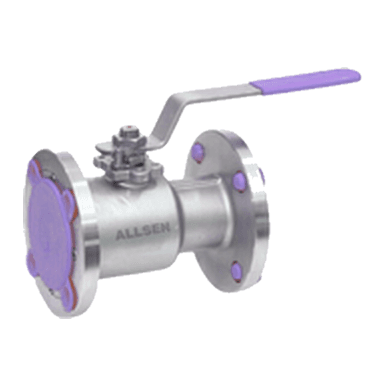
The ball valve is the isolation valve most engineers reach for first, and usually for the right reasons. A quarter turn takes it from shut to fully open, the bore is unobstructed so pressure drop is negligible, and the handle position tells you the valve state from across the plant room — no counting turns, no guessing.
It is an on/off device, though, and that distinction is the one worth holding onto. Parking a ball valve part-open to throttle puts the full pressure drop across a narrow crescent of seat, and the resulting erosion will destroy the seal that made the valve worth buying. Where you need to regulate flow, specify a globe valve and keep the ball valve for isolation.
Specifications.
Figures below are the catalogue envelope. Final model, seat and trim are confirmed against the ALLSEN catalogue before we quote.
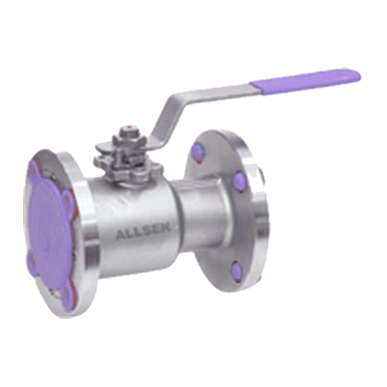
Ball Valves
Quarter-turn ball valves for isolation duty across water, HVAC and process lines. Screwed and socket-weld ends on the smaller sizes; flanged bodies at #150 and #300 for the larger installations. Lever operation as standard, with gear and actuated options.
| Size range | DN15 – DN300 |
|---|---|
| Material of construction | Cast iron, ductile iron, DUPLEX, aluminium bronze |
| Pressure rating | #150 & #300 |
| End connection | Screwed, socket weld, flanged |
| Operation | Manual | Gear | Actuated |
| Application | Wastewater, potable water, seawater, HVAC, data centres, sugar & ethanol |
Where this valve does the work.
Water & wastewater
Isolation on potable water, treated water and effluent lines, plus instrument and sampling take-offs where a compact, positive shutoff is needed.
Data centres & HVAC
Branch isolation on chilled-water circuits, CRAC/CRAH take-offs and make-up lines, where full-bore flow and unambiguous handle position both matter.
Chemical & process
Isolation on process transfer and dosing lines, in DUPLEX and aluminium bronze where the media rules out standard grades.
Seawater & marine
Aluminium bronze and DUPLEX bodies for seawater, desalination and coastal cooling duty where stainless would pit.
Isolation, not regulation — and specify the end connection early.
Ball valves are on/off devices. Fully open, the bore is clear and the seats see no differential; fully closed, the seats do their job across the whole face. Held part-open, all the pressure drop concentrates on a small arc of seat, and the resulting wire-draw erosion ruins shutoff. If the line needs throttling or flow regulation, a globe valve is the correct instrument.
End connection is the choice that's hardest to change later. Screwed ends suit small-bore utility and instrument lines; socket weld gives a leak-tight permanent joint on higher-integrity small-bore service; flanged is standard once the size and class rise and where the valve needs to come out for maintenance without cutting pipe. Decide this against your maintenance strategy, not just against the installer's preference.
Material follows the fluid. Cast and ductile iron for general water and HVAC, DUPLEX where chlorides and strength both matter, and aluminium bronze for seawater and desalination service. Send us the fluid, temperature and class and we'll specify body and seat together, then confirm the model against the ALLSEN catalogue.
Supplied mounted and bench-tested, not as loose parts.
Where the valve is automated, we supply valve and actuator as one assembly so the site team isn't marrying up components on a scaffold.
Rack & pinion pneumatic
Extruded aluminium body, tested to 2 million cycles, IP67, maximum torque 2100 Nm. The standard actuator for quarter-turn valves on plant air.
Vane type pneumatic
Patented spring-less design that replaces spring-return actuators for fail-safe duty. Eight models to 46,000 in-lb at 80 psi, −20 °C to 80 °C, AWWA C541 compliant, 2 year / 2 million cycle warranty.
Scotch yoke
Carbon steel scotch-yoke mechanism for severe service in chemical, petrochemical and offshore installations. IP67, maximum torque up to 250,000 Nm.
Electric
50–6000 Nm, AC 24/220/380 V or DC 12/24/48 V (±10%), −25 °C to 70 °C (−40 °C optional), IP67 standard with IP68 optional (15 m / 72 hr), on/off and modulating duty.
Other valves from the same catalogue.
Specifying a full line in one metallurgy is easier when isolation, regulation and non-return all come from the same source.
Butterfly Valves
Concentric, high-performance and triple-offset — every disc MOC
Dual Plate & Single Plate Wafer Check Valves
Wafer-type non-return valves, DN40–DN1200
Y-Type Strainers
In-line pipeline protection, DN25–DN400
Knife Gate Valves
Slurry, pulp and solids-laden service, DN50–DN1200
Gate Valves
Full-bore isolation to #2500, DN15–DN1200
Globe Valves
Throttling and flow regulation, DN15–DN600
Frequently asked questions
Can a ball valve be used to throttle or regulate flow?
It shouldn't be. Held part-open, the entire pressure drop concentrates across a narrow crescent between ball and seat, and the resulting high-velocity wire-draw erosion damages both — so the valve loses the tight shutoff you bought it for. Use a ball valve for isolation and a globe valve where you need to regulate. If you need throttling in a quarter-turn footprint, a high-performance butterfly valve with a characterised actuator is the better answer.
What is the difference between a ball valve and a gate valve for isolation?
Both give full-bore flow when open, but they behave very differently in service. A ball valve is quarter-turn — fast to operate, positive in shutoff, with visible position indication. A gate valve is multi-turn: slow to operate, but that slow closure is exactly what you want on a long liquid line where snapping a valve shut would generate surge. As a rule of thumb, ball valves win on small-bore and where fast, frequent, positive isolation matters; gate valves win at large bore and where slow closure protects the system.
Screwed, socket weld or flanged — which should I specify?
Screwed ends are economical and quick on small-bore utility, instrument and drain lines. Socket weld gives a permanent, leak-tight joint for higher-integrity small-bore service where a threaded joint would be a liability. Flanged is the standard for larger sizes and higher classes, and is what you want if the valve will ever need removing without cutting pipework. Match it to your maintenance access, because it's expensive to change afterwards.
Do you supply actuated ball valves?
Yes — with rack-and-pinion or vane-type pneumatic actuators for on/off duty, or electric actuators with on/off and modulating options. We supply the valve and actuator mounted and bench-tested as one assembly rather than as loose items for site assembly.
Which body material for seawater or high-chloride service?
Aluminium bronze or a DUPLEX grade — both are offered across this range. Standard stainless grades will pit in stagnant, aerated seawater, so for desalination intake, coastal cooling and marine duty we specify aluminium bronze or duplex. Send us the chloride level, temperature and whether the line sees stagnation.
Need ball valves quoted?
Share size, pressure class, fluid and temperature — we'll specify the valve and quote it with the actuator.