
Globe valves — for when the line needs regulating.
A disc closing perpendicular onto a horizontal seat, with the plug travelling along the flow axis. That geometry gives proportional, controllable flow and a seat that tolerates being held part-open — the thing gate and ball valves cannot do. DN15 to DN600, #150 through #2500.
- DN15–DN600
- #150 to #2500
- Throttling duty
- Flanged & buttweld
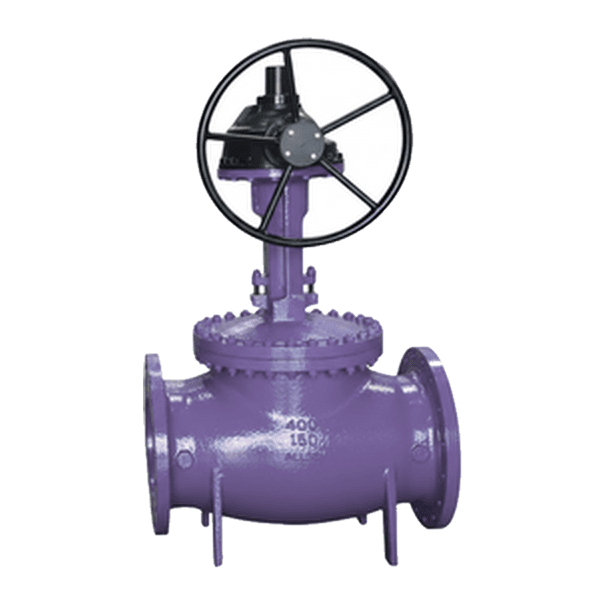
Every plant has a handful of lines that need to be set rather than switched — balancing a circuit, trimming a bypass, regulating make-up, controlling a warm-up line. Using a gate or ball valve for those duties is the single most common valve mistake we see, and it ends the same way every time: eroded seats and a valve that no longer shuts off.
The globe valve is built for exactly that job. Flow makes two right-angle turns through the body and passes between a disc and a horizontal seat, with the plug moving along the flow axis. Short stem travel gives fine, proportional control, and the seat geometry is designed to survive high-velocity flow at partial lift.
Specifications.
Figures below are the catalogue envelope. Final model, seat and trim are confirmed against the ALLSEN catalogue before we quote.
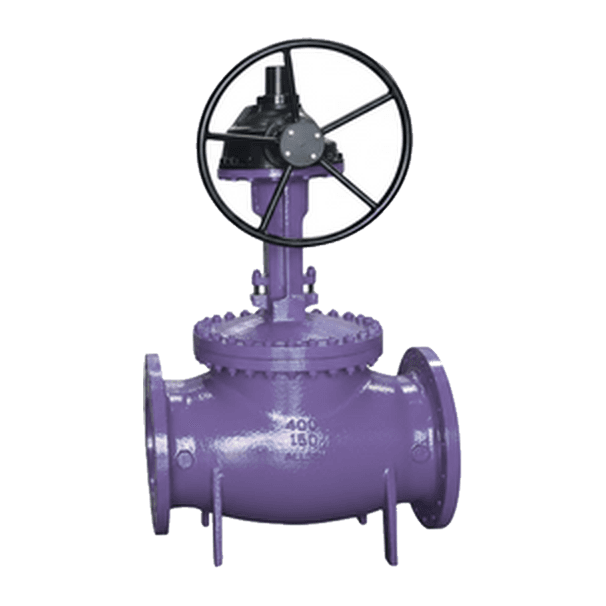
Globe Valves
Flanged and buttweld globe valves from DN15 to DN600, spanning #150 through #2500, in WCB, CF8, CF8M, CF3M, Gr. 4A–5A duplex, nickel aluminium bronze and aluminium alloys. Handwheel, bevel gear and actuated operation for regulating and modulating duty.
| Size range | DN15 – DN600 |
|---|---|
| Material of construction | WCB / CF8 / CF8M / CF3M / Gr. 4A–5A / NAB / aluminium alloys |
| Pressure rating | #150, #300, #600, #900, #1500, #2500 |
| End connection | Flanged, buttweld |
| Operation | Manual | Gear | Actuated |
| Application | Wastewater, pulp & paper, power plants, mining, chemical plants, oil & gas |
Where this valve does the work.
Flow regulation & balancing
Setting and trimming flow on bypass lines, balancing legs, recirculation and make-up — duties where the valve is meant to sit part-open for years.
Boiler & steam service
Feedwater regulation, warm-up and drain lines, blowdown and turbine auxiliaries, at the higher classes this range covers.
Chemical & process
Throttling on process and dosing lines in CF8M, CF3M and duplex, where both the corrosion resistance and the control characteristic matter.
Pump recirculation
Minimum-flow and recirculation lines that protect a pump running below its continuous-flow limit — a duty that would erode a gate valve within months.
You are buying a control characteristic, not just a body.
The trade-off for a globe valve's controllability is pressure drop. The flow path turns twice inside the body, so even wide open it costs you more head than a gate or ball valve of the same size. That is the price of proportional control, and it has to be in the hydraulic calculation from the start — not discovered at commissioning when the pump won't make duty.
Because of that drop, globe valves are usually sized on the required flow coefficient rather than on the line diameter, and it is entirely normal to end up with a globe valve one or two sizes below the pipe with reducers either side. A globe valve sized to the pipe generally does all its useful control in the first fraction of its travel, which gives you poor resolution and hammers the seat.
Then match the trim. Standard trim covers general regulating duty; harder trim materials are specified where the pressure drop is high enough to make cavitation or flashing a risk, which is what erodes seats fastest. Send us the flow range, inlet and outlet pressures and the fluid, and we'll size on Cv and specify the trim with it.
Supplied mounted and bench-tested, not as loose parts.
Where the valve is automated, we supply valve and actuator as one assembly so the site team isn't marrying up components on a scaffold.
Rack & pinion pneumatic
Extruded aluminium body, tested to 2 million cycles, IP67, maximum torque 2100 Nm. The standard actuator for quarter-turn valves on plant air.
Vane type pneumatic
Patented spring-less design that replaces spring-return actuators for fail-safe duty. Eight models to 46,000 in-lb at 80 psi, −20 °C to 80 °C, AWWA C541 compliant, 2 year / 2 million cycle warranty.
Scotch yoke
Carbon steel scotch-yoke mechanism for severe service in chemical, petrochemical and offshore installations. IP67, maximum torque up to 250,000 Nm.
Electric
50–6000 Nm, AC 24/220/380 V or DC 12/24/48 V (±10%), −25 °C to 70 °C (−40 °C optional), IP67 standard with IP68 optional (15 m / 72 hr), on/off and modulating duty.
Other valves from the same catalogue.
Specifying a full line in one metallurgy is easier when isolation, regulation and non-return all come from the same source.
Butterfly Valves
Concentric, high-performance and triple-offset — every disc MOC
Dual Plate & Single Plate Wafer Check Valves
Wafer-type non-return valves, DN40–DN1200
Y-Type Strainers
In-line pipeline protection, DN25–DN400
Ball Valves
Quarter-turn tight shutoff, DN15–DN300
Knife Gate Valves
Slurry, pulp and solids-laden service, DN50–DN1200
Gate Valves
Full-bore isolation to #2500, DN15–DN1200
Frequently asked questions
What is the difference between a globe valve and a gate valve?
Purpose, mostly. A gate valve is an isolation device: the wedge retracts fully clear of the bore, giving near-zero pressure drop when open, but it erodes if held part-open. A globe valve is a regulating device: flow turns twice through the body and passes between a disc and a horizontal seat, so it can sit part-open indefinitely and give proportional control — at the cost of a higher pressure drop even when fully open. Use gate valves to isolate, globe valves to regulate.
Why does a globe valve have such a high pressure drop?
Because of the S-shaped flow path through the body. The fluid changes direction twice and passes through a restricted seat area, and that geometry is exactly what gives the valve its control characteristic. You cannot have proportional control without a controlling restriction. The important thing is to account for that drop in the system hydraulics at design stage rather than discovering it during commissioning.
How should a globe valve be sized?
On flow coefficient (Cv), not on line size. Size it so that your normal operating flow sits in the mid-range of the valve's travel, where control resolution is best. A globe valve sized to match the pipe diameter typically does all its useful control within the first small fraction of lift — poor resolution, and hard on the seat. It is common and correct to fit a globe valve smaller than the line with reducers on either side.
Which way should flow go through a globe valve?
Conventionally, flow enters under the disc so that pressure helps lift it off the seat, which reduces the operating effort and gives smoother throttling. Some services — particularly high-pressure and steam applications — specify flow over the disc instead, to keep the stem packing under lower pressure when closed. Follow the arrow on the body, and if the service is unusual, tell us and we'll confirm the specified direction against the ALLSEN catalogue.
Can globe valves be actuated for modulating control?
Yes. The linear stem motion of a globe valve makes it a natural fit for modulating electric actuators (available in on/off and modulating duty across a 50–6000 Nm range) and for pneumatic actuation with a positioner. Because the stem travel is short and proportional, globe valves give better control resolution under an actuator than any quarter-turn valve.
Need globe valves quoted?
Share size, pressure class, fluid and temperature — we'll specify the valve and quote it with the actuator.