
Knife gate valves — built to shut through solids.
A sharpened gate that cuts through the medium instead of jamming in it. DN50 to DN1200 at PN4, PN6 and PN10, wafer, lugged or flanged, for slurry, pulp stock, sludge, fly ash and every other flow a conventional gate valve refuses to close against.
- DN50–DN1200
- PN4 / PN6 / PN10
- Slurry & pulp duty
- Wafer / lugged / flanged
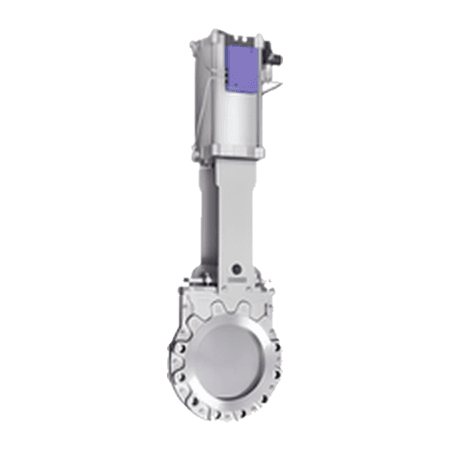
Put a conventional gate valve on a sludge or pulp line and it will eventually refuse to seat. Solids pack into the body cavity below the gate, the wedge lands on that packed bed and the valve stops short of closed — and every cycle after that makes it worse. The knife gate valve exists specifically to defeat that failure.
The gate is a flat plate with a bevelled, sharpened bottom edge running in a slim body with almost no cavity to pack. It shears through fibrous and settled solids as it descends and seats against a resilient or metal seat at the bottom. The face-to-face is short, the valve is light for its bore, and the whole thing is designed to be rebuilt in place.
Specifications.
Figures below are the catalogue envelope. Final model, seat and trim are confirmed against the ALLSEN catalogue before we quote.
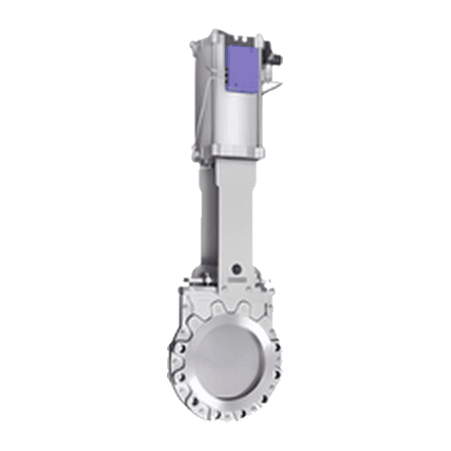
Knife Gate Valves
Wafer, lugged and flanged knife gate valves to DN1200 in cast iron, ductile iron, DUPLEX and aluminium bronze. Manual handwheel, bevel gear, or pneumatic cylinder and electric actuation for automated and remote-operated installations.
| Size range | DN50 – DN1200 |
|---|---|
| Material of construction | Cast iron, ductile iron, DUPLEX, aluminium bronze |
| Pressure rating | PN4, PN6, PN10 |
| End connection | Wafer, lugged, flanged |
| Operation | Manual | Gear | Actuated |
| Application | Wastewater, pulp & paper, power plants, mining, chemical plants |
Where this valve does the work.
Wastewater & sludge
Sludge transfer, digester lines, thickener underflow and screening channels in STPs and ETPs — the duties where a wedge gate valve packs solid and stops seating.
Pulp & paper
Stock lines, white water and reject handling, where fibrous material would bridge across a conventional gate. Knife gates are the industry-standard isolation valve on stock service.
Mining & minerals
Tailings, thickener underflow, mill discharge and slurry transfer, with the abrasion-resistant liners and DUPLEX construction those duties demand.
Power plant ash handling
Fly ash and bottom ash slurry lines, plus dry solids handling where the sharpened gate cuts through settled material on closure.
Specify by what's in the fluid, then by how it will be operated.
Knife gate valves are low-pressure by design — PN4 to PN10 across this range. That is not a limitation so much as a statement of purpose: slurry, sludge and stock lines run at modest pressure, and the trade for that ceiling is a valve that will actually close against solids. If you need high pressure isolation on clean fluid, you want a conventional gate valve instead.
Seat choice follows the media. Resilient seats give bidirectional, drop-tight shutoff on general wastewater and stock service. Metal seats take over on abrasive slurries and higher temperatures where an elastomer would be shredded. Body material runs from cast and ductile iron for general effluent up to DUPLEX and aluminium bronze on aggressive and chloride-bearing duty.
Then decide the operator, because it drives the installation. Handwheel is fine for occasional isolation; bevel gear for larger manual valves; a pneumatic cylinder where the valve cycles regularly or sits somewhere nobody wants to walk to. Automated knife gates on slurry lines cycle a great deal, so packing and gate finish matter more than they would on a manual valve.
Supplied mounted and bench-tested, not as loose parts.
Where the valve is automated, we supply valve and actuator as one assembly so the site team isn't marrying up components on a scaffold.
Rack & pinion pneumatic
Extruded aluminium body, tested to 2 million cycles, IP67, maximum torque 2100 Nm. The standard actuator for quarter-turn valves on plant air.
Vane type pneumatic
Patented spring-less design that replaces spring-return actuators for fail-safe duty. Eight models to 46,000 in-lb at 80 psi, −20 °C to 80 °C, AWWA C541 compliant, 2 year / 2 million cycle warranty.
Scotch yoke
Carbon steel scotch-yoke mechanism for severe service in chemical, petrochemical and offshore installations. IP67, maximum torque up to 250,000 Nm.
Electric
50–6000 Nm, AC 24/220/380 V or DC 12/24/48 V (±10%), −25 °C to 70 °C (−40 °C optional), IP67 standard with IP68 optional (15 m / 72 hr), on/off and modulating duty.
Other valves from the same catalogue.
Specifying a full line in one metallurgy is easier when isolation, regulation and non-return all come from the same source.
Butterfly Valves
Concentric, high-performance and triple-offset — every disc MOC
Dual Plate & Single Plate Wafer Check Valves
Wafer-type non-return valves, DN40–DN1200
Y-Type Strainers
In-line pipeline protection, DN25–DN400
Ball Valves
Quarter-turn tight shutoff, DN15–DN300
Gate Valves
Full-bore isolation to #2500, DN15–DN1200
Globe Valves
Throttling and flow regulation, DN15–DN600
Frequently asked questions
What is a knife gate valve used for?
Isolation on flows that carry solids — sewage sludge, pulp stock, mining tailings, fly ash slurry, powders and viscous media. The gate has a sharpened, bevelled bottom edge and runs in a body with almost no cavity, so it shears through fibrous or settled material rather than jamming on it. On those duties a conventional wedge gate valve packs solid below the gate and stops seating.
Knife gate vs conventional gate valve — how do I choose?
By what's in the fluid and by pressure. Knife gate: solids present, low pressure (PN4–PN10), short face-to-face, needs to close through the medium. Conventional gate: clean fluid, high pressure class (up to #2500 in this range), full-bore isolation with a wedge that seats metal-to-metal. If your line carries sludge, stock or slurry, it's a knife gate. If it carries clean water, steam or hydrocarbon at pressure, it's a gate valve.
Are knife gate valves bidirectional?
It depends on the seat. Resilient-seated knife gates are typically bidirectional and drop-tight in both directions. Metal-seated designs are often unidirectional, with a preferred flow direction marked on the body, and may allow a small permissible leakage rate by design. Tell us whether you need bidirectional shutoff and we'll confirm the specific seat arrangement against the ALLSEN catalogue before quoting.
Can knife gate valves be automated?
Yes — pneumatic cylinder actuation is very common on slurry and stock lines that cycle frequently, and electric actuation is available where compressed air isn't. We supply the valve and actuator assembled and tested. Bear in mind that automated knife gates cycle far more than manual ones, so packing specification and maintenance access matter more.
Why does my knife gate valve leak from the packing?
Gland packing on a knife gate wipes the gate on every stroke and is a consumable — a slow weep after long service is normal wear, not a failure. Retighten the gland evenly, and if that doesn't hold it, repack. Persistent leaks usually mean either a scored gate face (from abrasive media, which needs the gate replacing) or a gland over-tightened at commissioning, which scores the gate and creates the problem it was meant to solve. These valves are designed to be repacked in place.
Do you supply knife gate valves for ETP and STP projects in Delhi NCR?
Yes. Wastewater is core ground for us — Trading Engineers supplies pumps, blowers and now valves into ETPs and STPs across Delhi, Gurgaon, Noida, Ghaziabad, Manesar and Faridabad. Knife gates are usually quoted alongside the sludge pumps and aeration blowers on the same package.
Need knife gate valves quoted?
Share size, pressure class, fluid and temperature — we'll specify the valve and quote it with the actuator.