
Check valves that close before the column turns.
Dual plate and single-plate wafer type non-return valves — short face-to-face, spring-assisted closure and a fraction of the weight of a swing check. The standard answer to reverse flow on pump discharge headers where slam is the thing you're actually engineering against.
- Dual plate
- Single plate wafer
- DN40–DN1200
- Spring-assisted
- Non-slam
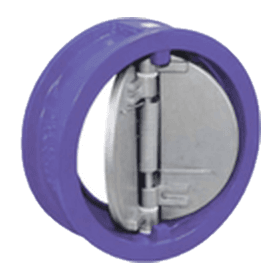
A check valve has one job — stop reverse flow — and exactly one failure mode that matters: closing late. When a pump trips, the water column decelerates, reverses, and if the disc is still open when that reversal arrives it slams shut against a moving column. That is where the pressure spike, the broken hangers and the cracked casings come from.
Wafer-type check valves solve this geometrically. The plates are light, the travel is short and a torsion spring starts them closing the moment forward flow decays, so the disc is already seated when reversal hits. Both ALLSEN wafer families are built on that principle — the choice between them is about line size and pressure class.
2 designs, specified to the duty.
Figures below are the catalogue envelope. Final model, seat and trim are confirmed against the ALLSEN catalogue before we quote.
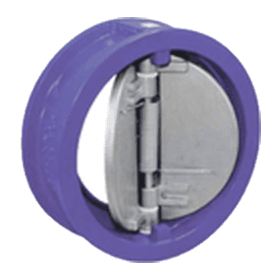
Dual Plate Check Valves
Two spring-loaded semicircular plates hinged on a central pin. Each plate travels only half the bore, so the inertia is roughly a quarter of an equivalent single disc — this is the design that actually earns the 'non-slam' description. Rated to #300 and available to DN1200, it is the default check valve on pump discharge headers.
| Size range | DN40 – DN1200 |
|---|---|
| Material of construction | Cast iron, ductile iron, DUPLEX, aluminium bronze |
| Pressure rating | #150 & #300 |
| End connection | Wafer, lugged, flanged |
| Application | Wastewater, potable water, seawater, HVAC, data centres, sugar & ethanol |
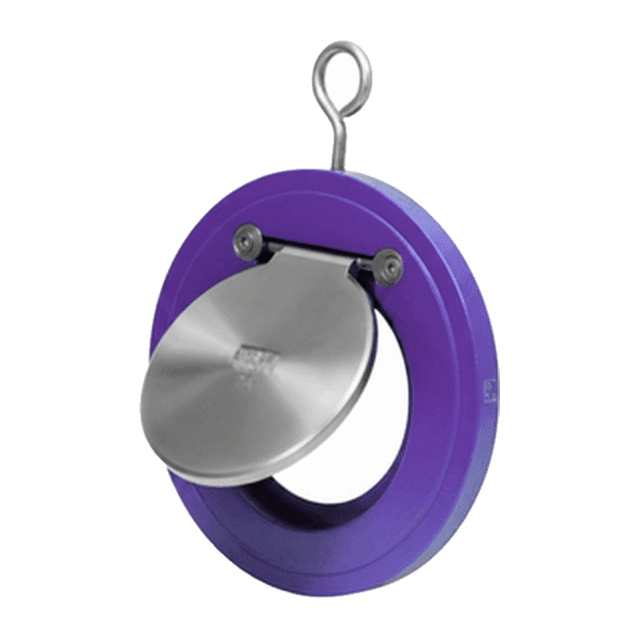
Single Plate Wafer Check Valves
A single hinged disc in a wafer body — the simplest and most economical non-return valve you can fit between two flanges. Ideal on shorter, lower-energy lines to DN600 where full non-slam behaviour isn't required and first cost and face-to-face length are what matter.
| Size range | DN40 – DN600 |
|---|---|
| Material of construction | Cast iron, ductile iron, DUPLEX, aluminium bronze |
| Pressure rating | PN10, PN16, #150 |
| End connection | Wafer |
| Application | Wastewater, potable water, seawater, HVAC, data centres, sugar & ethanol |
Dual plate or single plate — the deciding factors.
Both are wafer-type non-return valves and both fit between flanges. These are the four questions that actually decide which one goes on your line.
Line size
Single plate is offered to DN600; dual plate carries on to DN1200. Above DN600 the choice makes itself.
Pressure class
Single plate covers PN10, PN16 and #150. If you need #300, specify dual plate.
Slam risk
Long discharge lines, high static head, multiple pumps in parallel or frequent trips all raise reverse-flow energy. Dual plate's split, spring-loaded discs close faster and are the safer pick on every one of those.
First cost
On short, low-head, single-pump lines the single plate does the same job for less money. There is no merit in over-specifying a check valve on a duty that will never see a violent reversal.
Where this valve does the work.
Pump discharge headers
The primary application — preventing backflow through an idle or tripped pump in a parallel set, and protecting the impeller from reverse rotation.
Water & wastewater mains
Non-return protection on raw water, treated water and effluent transfer lines, including installations where the static head downstream is significant.
HVAC & data centres
Chilled-water and condenser-water circuits with duty/standby pump sets, where a slamming check valve transmits noise straight into an occupied building.
Process & industrial lines
Backflow prevention on process transfer, cooling water and utility headers where the wafer body's short face-to-face is worth having.
The check valve you want is the one that's already shut.
Sizing a check valve to the line size is the mistake we correct most often. A check valve sized to the pipe rather than the flow spends its life partly open, with the disc fluttering against the stop — that wears the hinge pin, wrecks the seat and leaves the disc a long way from its seat when reversal arrives. A check valve should be sized so that normal flow holds it fully open.
The second factor is what happens on trip. Reverse-flow energy scales with the length of the discharge line, the static head downstream and how fast the pump decelerates. High-energy installations — long rising mains, tall buildings, parallel pump sets — want the dual plate's split discs and torsion springs. On a short, low-head line the single plate wafer is entirely adequate.
Send us the pump curve, the discharge line length and profile, and the number of pumps in the set. We'll size the check valve on flow rather than on the pipe stamp, and confirm the model against the ALLSEN catalogue before quoting.
Other valves from the same catalogue.
Specifying a full line in one metallurgy is easier when isolation, regulation and non-return all come from the same source.
Butterfly Valves
Concentric, high-performance and triple-offset — every disc MOC
Y-Type Strainers
In-line pipeline protection, DN25–DN400
Ball Valves
Quarter-turn tight shutoff, DN15–DN300
Knife Gate Valves
Slurry, pulp and solids-laden service, DN50–DN1200
Gate Valves
Full-bore isolation to #2500, DN15–DN1200
Globe Valves
Throttling and flow regulation, DN15–DN600
Frequently asked questions
What is the difference between a dual plate and a single plate wafer check valve?
A dual plate check valve has two spring-loaded semicircular plates hinged on a central pin, so each plate sweeps only half the bore. A single plate wafer check has one hinged disc covering the full bore. Because the dual plate's discs are lighter, travel less and are spring-assisted, they close far faster on flow reversal — which is why dual plate is the standard non-slam choice. Single plate is simpler and cheaper, and is the right answer on short, low-head lines.
Do these check valves prevent water hammer?
They substantially reduce it, but no check valve eliminates surge on its own. Slam happens when the disc is still open as the column reverses; the dual plate's light, spring-loaded plates close before significant reverse velocity develops, which is what cuts the pressure spike. On genuinely high-energy systems — long rising mains, high static head — the check valve is one part of a surge strategy that may also need an air vessel, surge tank or controlled-closure valve. Share the line profile and we'll tell you honestly whether the check valve alone is enough.
Can a wafer check valve be installed vertically?
Dual plate check valves can generally be installed in horizontal or vertical lines with upward flow, because the springs — not gravity — drive closure. Single plate wafer checks are more orientation-sensitive and are usually specified for horizontal lines unless the model is confirmed for vertical service. Tell us the orientation up front and we'll confirm the specific model against the ALLSEN catalogue.
Why is my check valve chattering?
Almost always because it's oversized for the actual flow. If normal flow doesn't hold the disc firmly against its full-open stop, the disc floats and flutters — you hear it, and it destroys the hinge pin and seat over time. The fix is to size the valve on flow rate, not on pipe diameter, which sometimes means a check valve one size smaller than the line with reducers either side. Pump-discharge pulsation and a valve fitted too close to a pump or elbow will also do it.
What material should I specify for effluent service?
For general wastewater, ductile iron with an appropriate coating and stainless internals is the usual baseline. Where chlorides, seawater or aggressive effluent are involved, move to DUPLEX or aluminium bronze — both are offered across this range. Send us the fluid analysis and we'll specify body and plate materials against it.
Do you supply check valves matched to your pump packages?
Yes. Trading Engineers has supplied pumps since 1949, and check valves are quoted as part of the discharge package alongside the pump, panel and pressure vessel rather than as a separate line item. That way the check valve is sized against the actual duty point of the pump we're supplying.
Need check valves — dual & single plate quoted?
Share size, pressure class, fluid and temperature — we'll specify the valve and quote it with the actuator.